
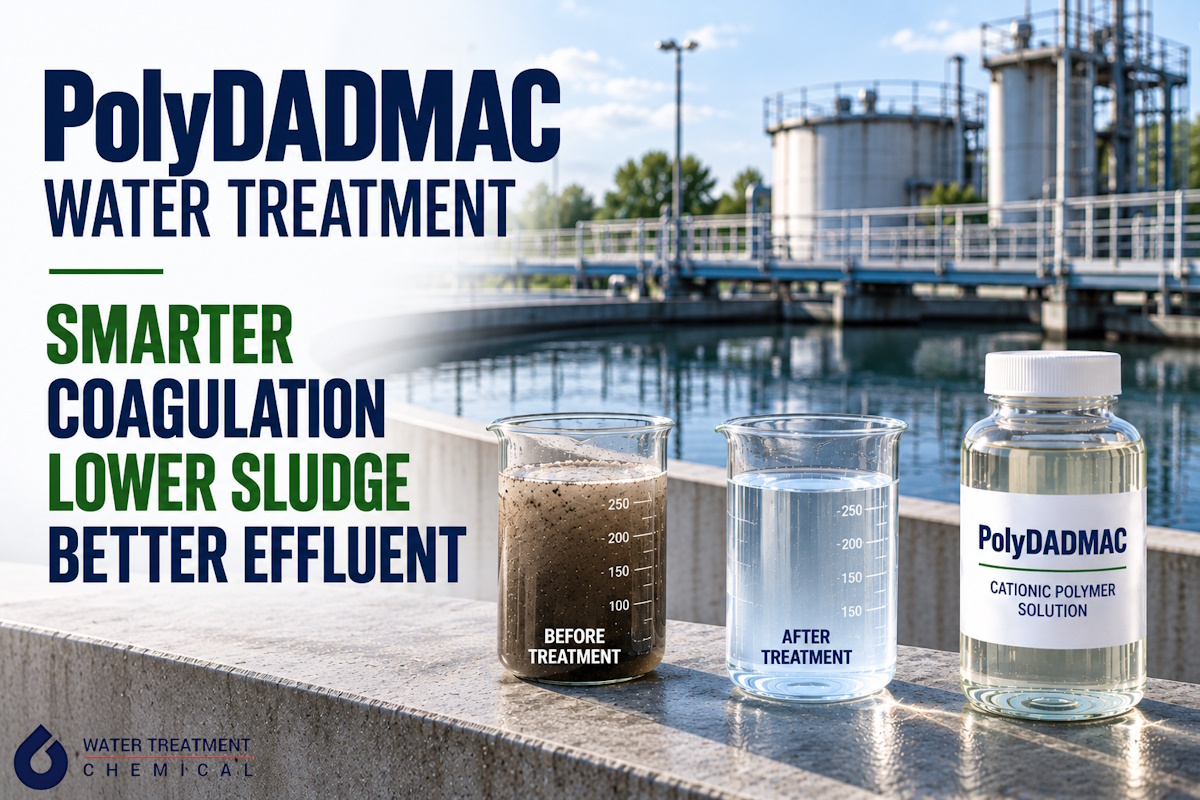
Industrial wastewater treatment plants face the constant challenge of managing highly variable effluent streams containing suspended solids, colloidal particles, and emulsified contaminants. Traditional inorganic coagulants like alum, ferric chloride, and conventional polyaluminium chloride have long been the industry standard for destabilizing these impurities. However, these inorganic salts often produce high volumes of heavy, water-bound sludge that is expensive to dewater, transport, and dispose of, while also significantly increasing the total dissolved solids (TDS) of the treated effluent. As environmental regulations become stricter and operational cost-efficiency becomes paramount, plant managers are increasingly turning to highly charged organic coagulants to optimize their primary clarification processes.
Among these organic solutions, polydadmac water treatment has emerged as one of the most efficient and versatile options for industrial wastewater clarification, sludge conditioning, and color removal. PolyDADMAC (poly diallyl dimethyl ammonium chloride) is a highly cationic polymer that excels at neutralizing the negative electrostatic charges on colloidal particles, allowing them to agglomerate into larger, easily settleable flocs. While highly effective, implementing this organic coagulant requires a thorough understanding of its selection criteria, polymer characteristics, and precise dosing requirements. Selecting the incorrect molecular weight or failing to optimize the dosing point can lead to poor solids separation, membrane fouling in downstream systems, and unnecessary chemical expenditures.
What is PolyDADMAC and How Does It Function?
PolyDADMAC is a linear homopolymer with a high cationic charge density, meaning it possesses a high concentration of positive charges along its polymer backbone. Unlike inorganic coagulants that rely heavily on sweep flocculation (where metal hydroxides precipitate and physically trap particles), PolyDADMAC operates primarily through charge neutralization and electrostatic patch mechanisms. Most colloidal impurities in industrial wastewater, such as clay, silica, organic matter, and emulsified oils, carry a negative surface charge. When PolyDADMAC is introduced, its positively charged sites rapidly bind to these negative surfaces, neutralizing the repulsive forces between the particles and allowing natural van der Waals forces to bring them together.
Depending on the specific treatment requirement, choosing a reliable cationic DADMAC supplier allows plant operators to access different molecular weight variations of this polymer. Low molecular weight polymers tend to act strictly as primary coagulants by creating localized electrostatic patches that attract other negatively charged colloids. High molecular weight formulations, on the other hand, provide a degree of bridging action where a single polymer chain can bind to multiple colloidal particles simultaneously, accelerating the formation of robust, shear-resistant flocs. Understanding this distinction is vital for processes subjected to high-shear mixing, such as dissolved air flotation (DAF) or high-speed centrifuges.
Key Benefits of Using PolyDADMAC in Industrial Effluent Treatment
Transitioning from traditional inorganic metal salts to a specialized organic coagulant program offers immediate operational and economic advantages. The first major benefit is the substantial reduction in sludge volume. Inorganic coagulants generate large amounts of metal hydroxide sludge, which retains water tenaciously. PolyDADMAC produces much more compact, hydrophobic flocs that release water easily, resulting in up to 50% less sludge volume and lower dewatering costs.
Another significant benefit of using polydadmac water treatment is its independence from wastewater pH. Unlike alum or iron salts, which have narrow optimal pH ranges (typically 5.5 to 7.5) and require extensive acid or caustic dosing for pH adjustment, PolyDADMAC remains highly stable and effective across a broad pH range from 4 to 10. This stability minimizes chemical consumption for pH control and simplifies plant operation. Additionally, because it is an organic polymer, it does not add dissolved metals like aluminum or iron to the treated water, nor does it increase TDS levels, making it highly compatible with downstream biological systems or reverse osmosis membranes. It can also be used in conjunction with a poly aluminium chloride RIP PAC supplier to optimize coagulant costs in highly demanding municipal or industrial processes.
Need a High-Performance Cationic Coagulant for Your ETP?
Critical Selection Criteria for Polydadmac Water Treatment
Selecting the correct PolyDADMAC formulation is not a one-size-fits-all process. Industrial plants must evaluate several critical factors before procuring or implementing a specific polymer grade. The primary consideration is the nature of the suspended solids and the overall charge demand of the wastewater. For instance, high-turbidity wastewater with a high concentration of inorganic clay particles will require a different molecular weight and active content percentage compared to wastewater from a textile dye house or a food processing plant containing complex organic molecules and emulsified fats.
Procurement teams and process engineers must also evaluate the active polymer concentration. Liquid PolyDADMAC is typically supplied in concentrations ranging from 10% to 50% active content. While a lower concentration product might have a cheaper purchase price per kilogram, it often results in higher overall chemical consumption, increased freight costs, and more frequent drum handling. Working directly with a reputable water treatment chemicals manufacturer like Rubmech ensures you receive detailed technical guidance on whether a concentrated liquid polymer or a customized blended formulation is the most cost-effective choice for your facility.
Furthermore, the presence of other chemical additives in your process must be evaluated. If your effluent contains high levels of anionic surfactants or synthetic detergents, they will rapidly consume the cationic charge of the PolyDADMAC, requiring a higher dosage to achieve clarification. In these situations, pre-treating the wastewater or using a dual-coagulant program with inorganic salts can help preserve the polymer for floc development. Additionally, downstream mechanical dewatering equipment, such as belt presses or centrifuges, will often perform better when the primary coagulation is optimized with PolyDADMAC and paired with a high-efficiency flocculant from an anionic PAM manufacturer.
Dosing and Application Guidelines for Industrial Wastewater
To achieve maximum coagulation efficiency and avoid operational failures, precise dosing is critical. Unlike inorganic coagulants, where over-dosing simply leads to chemical waste and increased sludge, over-dosing PolyDADMAC can cause severe treatment disruptions. Because it has such a high cationic charge density, adding too much polymer will coat the colloidal particles completely with positive charges. This leads to charge reversal, causing the particles to repel each other once again and restabilize in the water, which results in a sudden increase in turbidity and a distinct milky appearance in the clarifier.
Because wastewater characteristics fluctuate daily based on production schedules, universal dosing guidelines cannot be applied. Instead, plants must establish a reliable dosing protocol based on systematic laboratory testing:
- Jar Testing: This remains the standard diagnostic method. Operators should perform jar tests utilizing various dosages of PolyDADMAC to determine the exact point of charge neutralization, monitoring settleability, floc size, and supernatant clarity.
- Dosing Point Selection: The polymer must be added at a point of high-turbulence rapid mixing, such as just before a static mixer, an inline pump, or a rapid-mix tank. This ensures the viscous polymer is distributed uniformly across the entire wastewater stream within seconds of introduction.
- Dilution Requirements: Liquid PolyDADMAC is highly viscous. Feeding it directly to the wastewater stream without prior online dilution can lead to localized over-concentration, where some particles are over-dosed while others remain uncoagulated. Diluting the polymer to 0.1% to 0.5% concentration before the dosing point dramatically improves mixing efficiency.
- Reaction Time: After the rapid-mix phase, the wastewater should flow into a low-shear flocculation zone. This allows the neutralized particles to collide and grow into stable flocs without being sheared apart by high-velocity mixers.
Get a Tailored Chemical Dosing Recommendation
Troubleshooting Common Issues in PolyDADMAC Dosing
Even with robust system designs, ETP operators frequently encounter operational challenges when utilizing organic coagulants. The most common issue is charge restabilization caused by unexpected drops in wastewater turbidity or solids loading. If the incoming wastewater suddenly becomes cleaner, the existing polymer dosage becomes excessive, leading to the charge reversal mentioned earlier. To troubleshoot this, operators must perform quick colorimetric or jar tests to determine if lowering the chemical feed rate restores clarification.
Another common challenge is membrane fouling in plants that utilize ultrafiltration (UF) or reverse osmosis (RO) systems downstream of their clarifiers. If free, unreacted cationic PolyDADMAC carries over from the clarifier, it will bind strongly to the negatively charged surfaces of RO and UF membranes. This electrostatic binding creates a dense, sticky foulant layer that rapidly reduces permeate flux and increases transmembrane pressure. To prevent this, plant teams must ensure that the coagulation reaction is complete and that any residual cationic charge is neutralized before the water reaches membrane systems. Utilizing high-quality pretreatment chemicals from an RO plant treatment chemicals manufacturer can help mitigate membrane fouling and protect expensive membrane assets.
In colder climates or during winter seasons, the viscosity of liquid PolyDADMAC can increase significantly, making dosing pumps labor or lose calibration. Maintaining chemical storage tanks in temperature-controlled environments or implementing heat tracing on feed lines can resolve these viscosity issues, ensuring consistent chemical delivery.
Purchasing and Procurement Considerations for Industrial Buyers
Procuring water treatment chemicals involves more than finding the lowest price per unit. For procurement managers, the total cost of ownership (TCO) is the most critical metric. This includes chemical consumption rates, freight costs, storage space requirements, and downstream sludge disposal fees. Since PolyDADMAC reduces sludge volume and operates at lower dosages than inorganic coagulants, its higher initial price per kilogram is almost always offset by massive savings in sludge handling and chemical neutralization costs.
When sourcing these polymers, it is essential to partner with an established water treatment chemicals exporter like Rubmech. An experienced manufacturer can provide consistent polymer active content, batch-to-batch quality control, and tailored packaging solutions, such as 250 kg drums, 1000 kg IBC totes, or bulk road tankers to match your facility’s consumption rates. Furthermore, global exporters can assist with logistical requirements, ensuring seamless customs clearance and reliable supply chains to keep your treatment plant operating without interruption.
Choosing the Right Chemical Approach for Your Wastewater Treatment Plant
Optimizing an industrial effluent treatment plant requires a balance of high-quality chemistry, robust equipment, and precise operational control. Polydadmac water treatment offers an exceptional opportunity to improve clarification, minimize sludge production, and stabilize chemical costs, but its success depends entirely on proper formulation selection and accurate dosing. Relying on generic, off-the-shelf polymers without analyzing your specific wastewater characteristics can lead to system inefficiencies, chemical waste, and potential downstream equipment damage.
By collaborating with Rubmech, industrial facilities gain access to premium cationic coagulants, including advanced formulations like RUB FLOCK 220, alongside specialized technical support. Whether you need to resolve a persistent turbidity issue, lower your sludge disposal costs, or protect downstream membrane systems, a dedicated team of water treatment experts can help you conduct jar testing, perform onsite trials, and design an optimized chemical treatment program tailored to your plant’s unique operational needs.
Request a Custom Chemical Formulation and Quote