
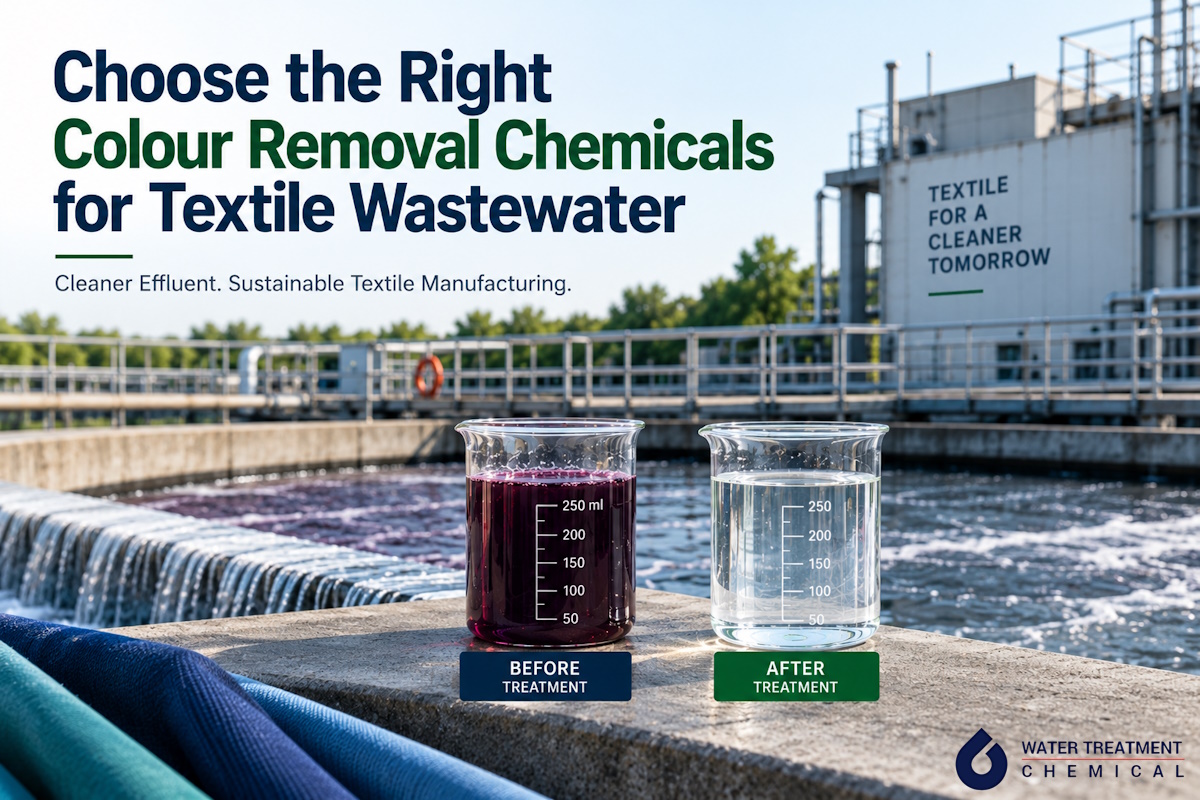
Textile manufacturing facilities generate highly complex wastewater streams characterised by intense colour, variable pH, high chemical oxygen demand (COD), and fluctuating salinity. Dyes used in modern fabric processing, especially reactive, direct, and disperse dyes, are intentionally designed to resist degradation, light, and washing. Consequently, conventional biological treatment systems in effluent treatment plants (ETPs) often fail to degrade these complex organic colour compounds completely. This leads to coloured discharges that violate strict environmental standards set by pollution control boards, risking regulatory penalties and plant shutdowns.
To achieve consistent compliance and discharge clear water, industrial facilities rely on specialised chemical treatment programmes. Selecting the most effective colour removal chemicals for textile wastewater is not a one-size-fits-all process; it requires deep operational knowledge of dye chemistry, wastewater characteristics, and physical-chemical treatment stages. When procurement teams and plant engineers understand how to evaluate, test, and apply these advanced decoloring formulations, they can significantly improve ETP performance, reduce sludge volume, and lower overall operational costs.
Understanding the Chemistry of Textile Dye Effluents
The selection of decoloring agents begins with a clear understanding of the specific dye groups present in the effluent. Different dye classes have distinct molecular structures and ionic charges, which dictate how they react with chemical treatment agents.
Reactive and Direct Dyes
Reactive and direct dyes are highly soluble in water due to their anionic sulfonic acid groups. These dyes form strong covalent bonds with cellulose fibres, but a significant portion, sometimes up to 30 percent, remains unfixed in the dye bath and ends up in the wastewater. Because they are highly soluble and carry negative charges, they do not settle easily. Treating these dyes requires cationic polymers that can effectively neutralise the negative charges, destabilising the soluble molecules so they can precipitate out of solution.
Acid and Disperse Dyes
Acid dyes are anionic and highly soluble, commonly used for nylon, wool, and silk. They respond well to strong cationic coagulants. Disperse dyes, used for polyester fabrics, are non-ionic and virtually insoluble in water. They exist as suspended microscopic particles in the wastewater. For disperse dyes, physical entrapment and standard coagulation using metal salts or medium-charge polymers are generally sufficient, unlike soluble reactive dyes which require highly specialised charge-neutralising agents.
Key Types of Colour Removal Chemicals for Textile Wastewater
Industrial operators use several chemical categories to decolorise textile wastewater, often combining them to achieve the highest removal efficiency at the lowest treatment cost.
Cationic Polyamine Decoloring Agents
Polyamine-based decoloring agents are specialised organic polymers with a high density of cationic (positive) charges. These polymers are designed to attract, bind, and neutralise the anionic soluble dye molecules in the effluent. By forming strong ionic complexes, they convert soluble dyes into insoluble microflocs. A leading example is the formulations produced by a dedicated color removal chemical manufacturer, which work efficiently on reactive, acid, and direct dyes without significantly altering the pH of the wastewater.
Inorganic Coagulants
Inorganic coagulants, such as alum, ferrous sulphate, and polyaluminium chloride (PAC), are widely used in textile ETPs. They provide cost-effective primary coagulation by neutralising charges and forming hydroxide precipitates that sweep suspended particles out of the water. Many plants find that partnering with a reliable poly aluminium chloride RIP PAC supplier allows them to use PAC in combination with organic decoloring polymers, achieving superior colour removal while keeping chemical consumption balanced.
Need Help Selecting the Right Decoloring Agent?
How to Match Wastewater Characteristics with Chemical Selection
Before purchasing colour removal chemicals for textile wastewater, operators must evaluate several operational parameters. The chemistry of the wastewater changes constantly based on production schedules, fabric types, and the washing processes employed in the mill.
The Influence of Wastewater pH
Wastewater pH is a critical factor in chemical decoloring performance. Inorganic coagulants like alum and ferrous sulphate are highly sensitive to pH, operating efficiently only within narrow windows. If the pH is too high or too low, these metal salts fail to precipitate, leaving dissolved metals in the treated water. Conversely, advanced organic cationic polyamines exhibit stable performance across a much wider pH range, typically from 6.0 to 10.0, reducing the need for aggressive acid or alkali dosing prior to coagulation.
The Impact of Surfactants and Auxiliaries
Textile processing uses massive quantities of surfactants, dispersing agents, and chelating chemicals. These auxiliary chemicals are designed to keep substances suspended in water, meaning they actively oppose coagulation. High levels of anionic surfactants can consume a significant portion of the cationic decoloring agent, requiring higher chemical dosages to achieve the target colour removal. Choosing a high-charge decoloring polymer helps overcome this interference without generating excessive sludge.
The Role of Flocculants in Improving Settling Speed
Once the decoloring chemical neutralises the dye molecules to form microflocs, these small particles must be gathered into larger, heavier masses that settle quickly in the clarifier. This is where polyelectrolytes are introduced into the treatment stream. Working with an anionic polyacrylamide manufacturer allows ETP managers to source high-molecular-weight polymers that bridge the microflocs together. For specific sludge dewatering systems, a cationic polyacrylamide supplier can provide polymers that improve cake dryness and filtration speed. Integrating these chemicals for effluent treatment plants creates a cohesive, highly efficient settling process.
The Critical Step: Conducting Effective Jar Testing
Because textile effluent quality fluctuates hourly, universal chemical dosage recommendations do not exist. To avoid chemical wastage and treatment failures, plant teams must perform routine jar testing to determine the precise chemical recipe.
Step-by-Step Jar Testing Protocol
- Collect a Representative Sample: Obtain a fresh wastewater sample directly from the equalization tank, ensuring it represents the current production cycle.
- Adjust the pH: Measure and record the baseline pH. If necessary, adjust the pH to the optimal operating range of the specific chemicals being tested.
- Dosing the Decoloring Agent: Add varying concentrations of the cationic polymer to different jars (for example: 20 ppm, 40 ppm, 60 ppm, and 80 ppm) under rapid mixing conditions.
- Rapid Mixing (Coagulation Phase): Agitate the samples rapidly at 100 to 120 RPM for 1 to 2 minutes to ensure the decoloring chemical is completely distributed and contacts all dye molecules.
- Slow Mixing (Flocculation Phase): Add a small dose of anionic polyelectrolyte (typically 1 to 3 ppm) and reduce the mixing speed to 20 to 30 RPM for 10 to 15 minutes to allow large flocs to build without shearing.
- Settling and Evaluation: Turn off the mixer and allow the flocs to settle for 15 to 30 minutes. Observe the settling rate, sludge volume, and the clarity of the supernatant.
Evaluating the Results
The ideal chemical programme provides the maximum reduction in colour and COD with the lowest dose and minimum sludge generation. If the supernatant remains cloudy, the dosage may be insufficient. However, if the water turns cloudy after showing initial clarity, it indicates overdosing, which restabilises the suspended particles.
Request a Chemical Sample for Lab Testing
Operational Challenges and Chemical Overdosing Risks
One of the most common operational errors in textile ETPs is the over-application of polymeric colour removal chemicals. Operators often assume that if a small dose improves colour removal, a larger dose will perform even better. In reality, overdosing leads to several severe process challenges.
Charge Reversal and Re-suspension
When too much cationic polymer is added to the wastewater, it completely saturates the anionic sites on the dye molecules and leaves an excess of positive charges in the water. These positively charged particles then repel each other, preventing aggregation. This phenomenon, known as charge reversal, causes the treated water to become turbid, hazy, and colored once again, wasting expensive chemicals and degrading effluent quality.
Increased COD and Membrane Fouling
Excess organic polymers that do not react with dyes remain dissolved in the effluent. This unreacted polymer directly increases the chemical oxygen demand (COD) of the treated water. Furthermore, if the effluent is directed to a reverse osmosis (RO) system for water recovery, these free cationic polymers can deposit onto the membrane surfaces, causing rapid, irreversible organic fouling that shortens membrane lifespan and increases cleaning costs.
Procurement Considerations for Bulk Chemical Supply
Selecting the right chemical supplier involves more than comparing price per kilogram. Procurement managers must look at technical support, product consistency, and logistical capabilities to secure a stable chemical supply.
Assessing Chemical Active Content
Commercial colour removal chemicals for textile wastewater are supplied at various concentrations. A cheaper product often has a lower active polymer content, meaning the plant will need to dose more product to achieve the same result. Procurement teams should evaluate the cost per active unit rather than the raw cost per liquid kilogram to understand the true cost of treatment.
Reliable Sourcing and Manufacturing Expertise
Working directly with a reputable industrial wastewater treatment chemical supplier or manufacturer ensures consistent product quality from batch to batch. Variations in polymer molecular weight or charge density can disrupt automated dosing systems, leading to fluctuating treatment outcomes. Reliable manufacturers, such as Rubmech, maintain strict quality control standards to deliver dependable formulations for domestic and export markets.
When organizing bulk procurement, facilities should request water treatment chemical quotation details that cover technical support, safety data sheets (SDS), jar testing guidance, and batch analysis reports to verify the parameters of the chemicals before delivery.
Discuss Your Bulk Chemical Requirements
Selecting the Ideal Decoloring Agent for Your Textile ETP
Optimising a textile effluent treatment plant requires a balance of chemistry, operational discipline, and reliable chemical supply. Because dye compositions change with fashion trends and fabric demands, your chemical treatment strategy must remain adaptable. Investing time in laboratory jar testing, monitoring pH levels, and adjusting polymer ratios ensures that your facility consistently meets discharge standards while keeping operational overheads low.
By partnering with an experienced chemical manufacturer like Rubmech, textile plants gain access to high-performance decoloring agents, coagulants, and flocculants tailored to specific wastewater profiles. This collaborative approach helps industrial facilities minimize chemical consumption, control sludge volumes, and ensure stable, worry-free environmental compliance.