
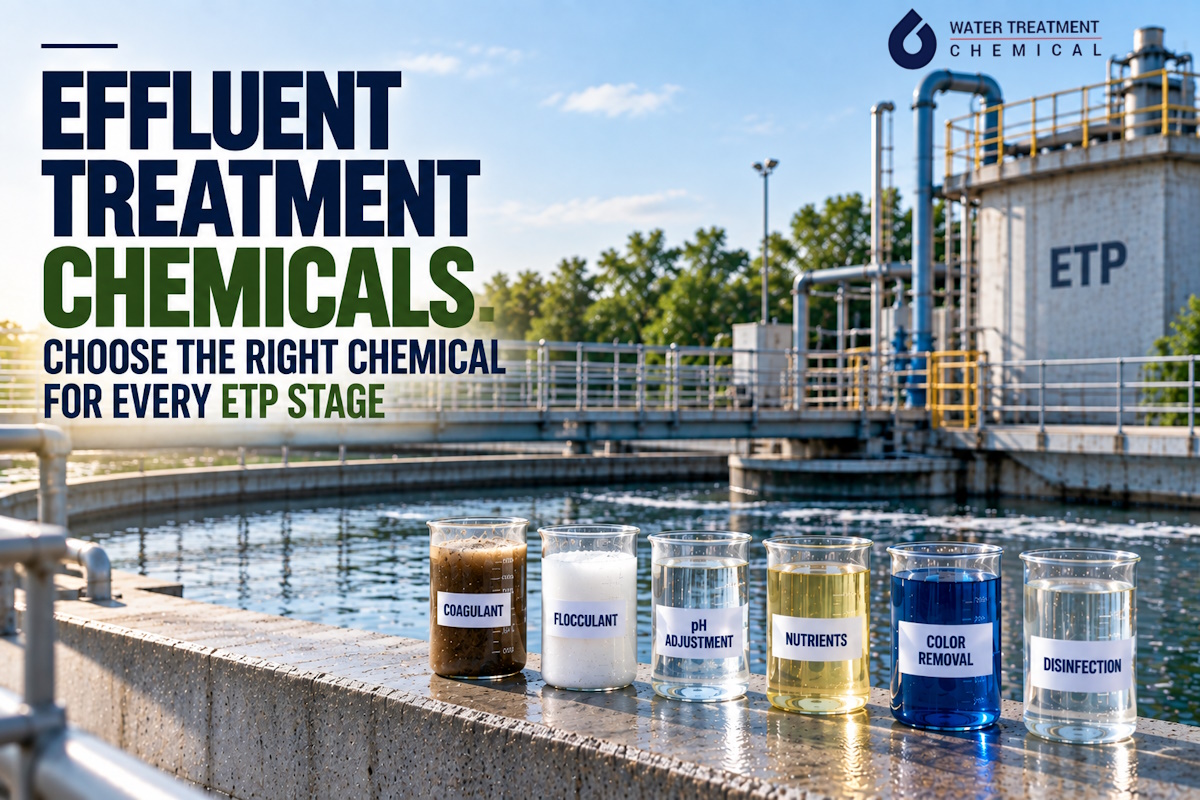
Industrial manufacturing processes generate vast volumes of wastewater containing suspended solids, dissolved organic matter, heavy metals, and complex chemicals. Managing this wastewater effectively requires a well-structured Effluent Treatment Plant (ETP) that relies on precise mechanical, biological, and chemical processes. Selecting the right effluent treatment chemicals is not merely a matter of regulatory compliance; it directly affects the operating efficiency, equipment life, and overall operating costs of the facility. Without a targeted chemical strategy, plants risk discharging non-compliant water, damaging expensive downstream equipment, or accumulating excessive sludge.
Every effluent treatment plant functions as a multi-stage system where the output of one treatment step serves as the input for the next. This sequential design makes the selection of chemicals highly critical because an error in the primary stage can disrupt biological processes or degrade tertiary treatment efficiency. Industrial plant operators, procurement teams, and facility managers must understand how different effluent treatment chemicals function at each stage of the ETP. This understanding enables them to choose products that achieve maximum contaminant removal with minimal chemical consumption.
The Primary Stage: Coagulation and Flocculation Mechanisms
Primary treatment focuses on removing suspended solids, colloidal particles, oils, and greases. These contaminants carry negative electrical charges that keep them suspended in the water, preventing them from settling naturally. Coagulants work by neutralizing these negative charges, allowing the micro-particles to collide and form larger masses. Traditional inorganic coagulants, such as alum or iron salts, are widely used, but modern applications benefit greatly from advanced formulations. Partnering with a specialized poly aluminium chloride RIP PAC manufacturer ensures access to high-basicity coagulants that work effectively across a broad pH range while generating less sludge than conventional alum.
Once coagulation destabilizes the charges, flocculants are introduced to bind the micro-flocs into large, stable, and easily filterable aggregates. This step relies on high-molecular-weight polymers known as polyelectrolytes. Depending on the ionic charge of the suspended particles, operators select anionic, cationic, or non-ionic polymers. An anionic PAM supplier can provide polymers that accelerate the settling rate of heavy, inorganic solids in primary clarifiers. Proper flocculation improves the clarity of the overflow water, reducing the solids load entering subsequent biological treatment systems.
The interaction between coagulants and flocculants must be carefully balanced. Over-coagulation can restabilize the particles by giving them a positive charge, which prevents flocculation and leads to turbid effluent. Conversely, under-dosing results in pin-floc formation, where particles are too small to settle quickly, leading to carryover into downstream units. System parameters such as mixing energy, retention time, and water temperature also influence floc growth and settling rates.
pH Neutralisation and Chemical Dosing Control
Wastewater entering an ETP rarely possesses a neutral pH. Industrial effluents from textile, pharmaceutical, food processing, and chemical manufacturing can be highly acidic or alkaline. Achieving pH neutralization is critical because extreme pH levels inhibit biological activity in secondary stages and prevent coagulants from functioning efficiently. Standard neutralizing agents include sulfuric acid, hydrochloric acid, sodium hydroxide (caustic soda), and calcium hydroxide (lime).
The choice of neutralization chemical depends on the specific characteristics of the influent. For example, lime not only raises pH but also aids in precipitate formation for heavy metals and sulfates, though it increases the overall sludge volume. Caustic soda is easier to handle and dose but lacks the coagulant-aid properties of lime. Automated chemical dosing systems must be calibrated to adjust to fluctuations in raw wastewater quality. This ensures that the pH remains within the optimum range of 6.5 to 8.5 before the water proceeds to biological treatment.
In addition to biological compatibility, pH control is vital for chemical precipitation reactions. Many heavy metals, such as copper, nickel, and zinc, exhibit minimum solubility at specific pH ranges. Dosing neutralizing agents to target these exact ranges allows the metals to precipitate as hydroxides, which can then be removed during primary clarification. Precision in dosing prevent chemical waste and avoids the corrosive conditions that damage metallic pipework and concrete basins.
Need Help Selecting the Right Coagulants and Flocculants?
The Secondary Stage: Nutrient Balancing and Biological Health
The secondary stage of an ETP relies on microorganisms to degrade dissolved organic matter, measured as Chemical Oxygen Demand (COD) and Biochemical Oxygen Demand (BOD). Biological systems, such as activated sludge processes, sequencing batch reactors (SBR), or moving bed biofilm reactors (MBBR), require a stable environment to maintain biomass health. This requires careful management of macronutrients, primarily nitrogen and phosphorus.
If the raw wastewater is deficient in these elements, operators must dose urea and diammonium phosphate (DAP) to maintain the optimal COD to Nitrogen to Phosphorus ratio, typically targeted at 100:5:1 for aerobic systems. Nutritional deficiencies lead to poor biomass development, filamentous bulking, and pin-floc issues in secondary clarifiers. Continuous monitoring of nutrient levels in the aeration tank ensures that the microbes remain active and capable of digesting organic pollutants efficiently.
In addition to nutrient balancing, biological systems frequently suffer from foaming issues caused by filamentous bacteria, surfactants, or rapid changes in organic loading. Foaming reduces oxygen transfer rates, creates environmental hazards around the basins, and leads to solids carryover. Dosing silicone-based or organic defoamers helps suppress this foam, preventing operational hazards and maintaining oxygen transfer efficiency within the aeration tanks without harming the active microbial population.
The Tertiary Stage: Colour Removal, Disinfection, and Polishing
Tertiary treatment represents the final polishing step before wastewater is discharged or recycled for reuse. Industries like textiles and pulp and paper generate highly colored wastewater that biological systems cannot completely degrade. Colour removal requires advanced chemical treatment. Sourcing from a reliable color removal chemical manufacturer provides operators with highly cationic liquid polymers designed to break the molecular bonds of organic dyes, precipitating the color compounds out of the solution.
Disinfection is another key element of tertiary treatment, particularly when the treated effluent is reused or discharged into sensitive environments. Chlorine dioxide, sodium hypochlorite, and ozone are commonly used to eliminate pathogens and control biological growth in storage systems. Oxidizing biocides also help eliminate residual trace organics, reducing the overall biological oxygen demand of the final discharge to meet stringent environmental standards.
For systems utilizing reverse osmosis (RO) plants for zero liquid discharge (ZLD) schemes, tertiary chemical treatment must protect downstream membranes. Dosing chlorine scavengers, such as sodium metabisulfite, prevents oxidizing biocides from degrading polyamide membranes. Similarly, high-performance antiscalants are dosed to prevent mineral scaling on the membrane surfaces, extending membrane life and reducing the frequency of chemical clean-in-place (CIP) cycles.
Optimize Your ETP Chemical Dosing Process Today
Sludge Treatment and Dewatering Stage
The physical, chemical, and biological processes within an ETP generate significant volumes of sludge. Disposing of wet sludge is highly expensive and logistically challenging due to its high water content. The dewatering stage aims to reduce sludge volume by separating water from the solid mass, producing a dry cake suitable for disposal or land application. This process utilizes dewatering equipment such as filter presses, centrifuges, and belt presses.
To achieve optimal cake dryness and clean filtrate water, operators must use high-performance dewatering polymers. Consulting with a cationic PAM manufacturer allows plants to select polymers with the specific molecular weight and charge density required to bind organic biological sludge. These cationic polyelectrolytes destabilize the negatively charged organic solids, releasing bound water and facilitating rapid filtration. Efficient sludge dewatering directly reduces disposal costs, transport requirements, and overall environmental impact.
The mechanical configuration of the dewatering equipment dictates the choice of polymer. Centrifuges subject the sludge to high shear forces, requiring high-molecular-weight polymers that form extremely robust flocs. Filter presses and belt presses operate under lower shear conditions but require rapid water release, which is best achieved using polymers with medium-to-high charge densities. Regular testing of the sludge cake dryness ensures that the dewatering system operates at peak economic and physical efficiency.
How to Systematically Choose Your Effluent Treatment Chemicals
Selecting effluent treatment chemicals is an ongoing, analytical process rather than a static decision. To avoid chemical waste, high operating costs, and system failures, industrial plants must follow a systematic selection methodology. Selecting the wrong chemical at any stage can lead to poor settling, high chemical consumption, or non-compliant discharge parameters.
First, operators should conduct a comprehensive wastewater analysis. Knowing the exact concentrations of suspended solids, pH, COD, heavy metals, and oil is vital. A chemical program designed for textile waste will fail if applied to pharmaceutical or food processing wastewater due to differences in organic molecular structures and contaminant loads.
Second, jar testing remains the gold standard for chemical selection and dosage optimization. This bench-scale test allows operators to simulate the coagulation and flocculation processes under controlled conditions. By testing various combinations of coagulants, flocculants, and decoloring agents, operators can determine the optimum dosage, pH range, and settling times before implementing changes on a full plant scale. Regular jar testing is necessary to account for seasonal variations in raw water quality or production-led changes in wastewater composition.
Third, consider chemical compatibility. Using chemicals from a single, reliable industrial wastewater treatment chemical supplier ensures that different treatment stages work synergistically. For instance, residual cationic polymers from a primary stage must not interfere with secondary biological processes or tertiary membrane filtration systems. Applying chemicals for effluent treatment plants requires a holistic view of the entire water loop to prevent chemical antagonism and ensure stable operating conditions.
Evaluating Chemical Suppliers and Technical Support
Procuring effluent treatment chemicals is not just about finding the lowest cost per kilogram. The total cost of ownership in an ETP includes chemical consumption rates, sludge disposal fees, maintenance costs, and potential regulatory fines. A low-cost, low-purity chemical may require double the dosage of a premium formulation, resulting in higher overall operating costs and increased sludge production.
When evaluating potential chemical suppliers, check their manufacturing capabilities, quality control standards, and ability to provide consistent technical support. A supplier should be able to assist with product selection, jar testing, and dosage optimization trials. They should also possess a deep understanding of the regulatory requirements in your region to help ensure that your treated effluent always meets discharge norms.
Additionally, assess the supplier’s logistics and supply chain stability. ETP operations cannot afford downtime due to delayed chemical deliveries. A reliable manufacturing partner with robust inventory management and global export capabilities guarantees a steady supply of critical chemicals, protecting your plant from operational disruptions and compliance issues.
Selecting the Right Chemical Partner for Your ETP
Establishing an efficient effluent treatment process requires high-quality chemical formulations tailored to your plant’s specific operational parameters. Relying on generic chemicals often leads to high consumption rates, excessive sludge production, and unstable treatment results. Industrial facilities must work with manufacturers who provide technical guidance, laboratory support, and high-performance products.
Rubmech offers a comprehensive portfolio of coagulants, flocculants, decoloring agents, and specialty formulations designed for diverse industrial applications. Working with a dedicated technical team allows you to diagnose operational bottlenecks, optimize chemical feed rates, and ensure consistent compliance with regional pollution control board guidelines. To find the optimal chemical solution for your plant, you can request water treatment chemical quotation or consult with our technical specialists to run laboratory trials on your wastewater samples.