
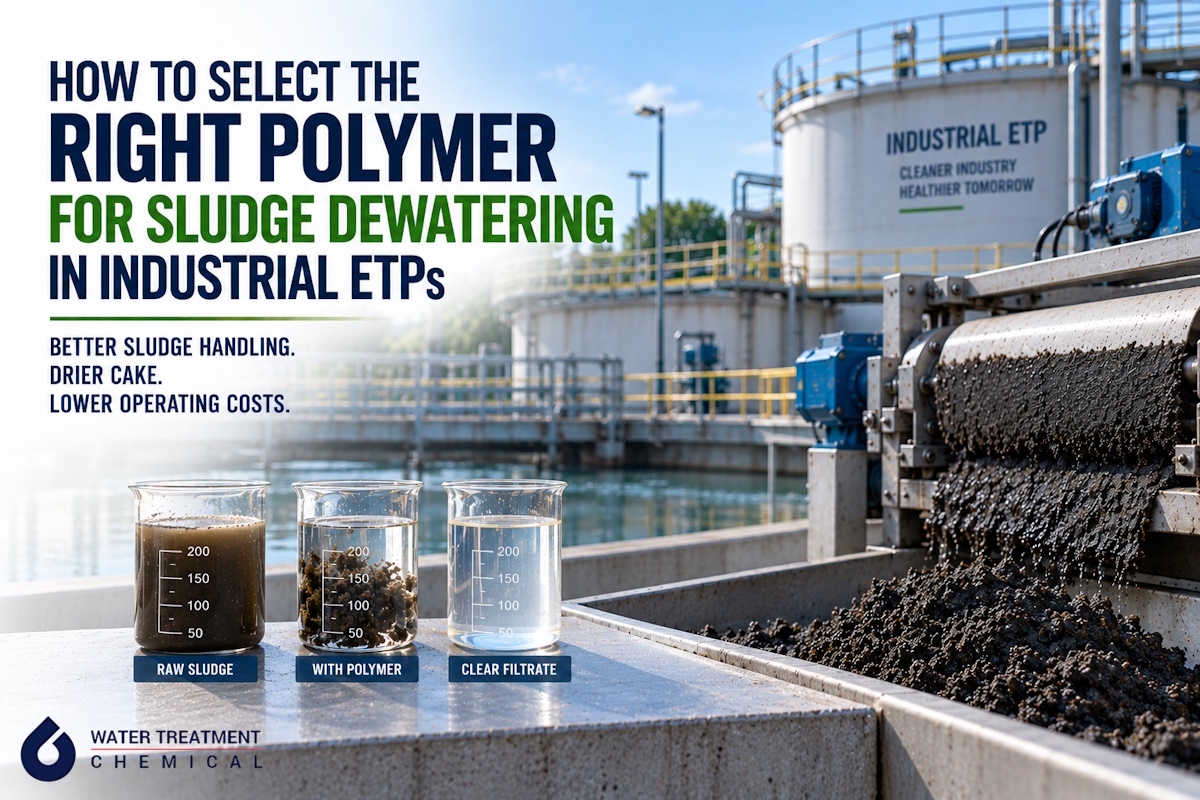
Industrial wastewater treatment systems generate a significant volume of sludge that must be dewatered before transport, reuse, or landfill disposal. Sludge handling, haulage, and disposal represent a major portion of the operational budget for any manufacturing facility. To minimize these costs, Effluent Treatment Plants (ETPs) must maximize the dryness of the discharged cake, a process that is highly dependent on selecting the correct polymer for sludge dewatering. The wrong chemical choice leads to wet cake, rapid blinding of filter media, high disposal fees, and excessive chemical wastage.
Choosing an effective flocculant is not a simple, one-size-fits-all decision. Sludge characteristics, organic loading, ionic charge, and the mechanical design of the dewatering equipment all influence chemical performance. Understanding how these chemical and physical variables interact allows plant managers, environmental engineers, and procurement teams to select a polymer programme that optimizes solid-liquid separation while lowering overall treatment expenses.
How Sludge Characteristics Influence Polymer Selection
The origin and nature of the wastewater sludge dictate its chemical properties. Before choosing a polymer, it is essential to determine whether the sludge is primary, secondary, digested, or a blend of different waste streams. Each type of sludge possesses unique surface charges and water-binding capacities that affect how it reacts to conditioning chemicals.
Primary sludge is typically inorganic and composed of larger, heavier particles that settle relatively easily. This type of sludge often requires lower chemical dosages because it contains less bound water. In contrast, secondary biological sludge consists of cellular mass, bacterial extracellular polymeric substances, and organic colloidal particles. These biological matrices carry a high negative surface charge and hold water tightly within their structure, making them highly resistant to dewatering. Consequently, biological sludge requires a highly targeted chemical approach to destabilize the colloidal suspension and release the bound water. Selecting the appropriate coagulants and flocculants from a reliable ETP chemicals supplier is the first step toward managing these challenging sludge characteristics.
Mixed sludge, which combines primary and secondary solids, presents a moving target for ETP operators. If the ratio of primary to biological sludge fluctuates due to production changes or process upsets, the polymer demand will also shift. High-organic sludges typically require cationic polymers with high charge densities to neutralize surface charges, while inorganic sludges are often treated more effectively with anionic polymers. Failing to match the chemical charge to the sludge type results in weak floc formation and poor drainage.
Cationic, Anionic, or Non-Ionic: Navigating Polymer Types
Polymers used in sludge conditioning are synthetic organic macromolecules called polyelectrolytes. They work through two primary mechanisms: charge neutralization and bridging. Charge neutralization occurs when the ionic groups on the polymer chain counteract the surface charges of the suspended particles, allowing them to clump together. Bridging occurs when long polymer chains attach to multiple particles simultaneously, forming large, heavy aggregates called flocs.
- Cationic Polymers: These polymers carry a positive charge and are the most common choice for biological and organic sludges, which are naturally negatively charged. The positive sites on the polymer bind to the negative sites on the organic solids, releasing bound water and forming dense, stable flocs. Operators should work with a trusted cationic PAM supplier to evaluate the optimal charge density for their specific biological waste stream.
- Anionic Polymers: Carrying a negative charge, anionic polyelectrolytes are primarily used for highly inorganic sludges, such as those generated in mining, metal finishing, stone cutting, or coal washing processes. They assist in agglomerating heavy mineral particles. A specialized anionic PAM supplier can help determine the correct molecular weight needed to handle heavy inorganic particulate loads.
- Non-Ionic Polymers: These polymers carry no electrical charge. They rely entirely on hydrogen bonding and physical bridging to clump particles. Non-ionic polyelectrolytes are typically used in highly acidic, highly saline, or highly complex chemical environments where charged polymers would lose their effectiveness. Consulting a non ionic polyacrylamide supplier is advisable when treating complex chemical or textile wastewaters that contain high concentrations of dissolved salts.
Need Help Selecting the Right Dewatering Polymer?
Balancing Molecular Weight and Charge Density
When selecting a polymer for sludge dewatering, two technical specifications are critical: charge density and molecular weight. These properties determine how the polymer behaves in solution and how well the resulting flocs can withstand the mechanical forces exerted by dewatering equipment.
Charge density refers to the percentage of ionic monomers along the polymer chain. It ranges from very low (less than 10 percent charge) to very high (over 80 percent charge). The optimal charge density is achieved when the polymer exactly neutralizes the repulsive charges between sludge particles, allowing them to draw close together. If the charge density is too low, the particles remain dispersed. If it is too high, the polymer can actually restabilize the suspension, preventing effective settling and filtration.
Molecular weight represents the length and size of the polymer chain. High molecular weight polymers have very long chains that excel at bridging particles to create large flocs. However, these long chains are highly sensitive to mechanical shear. If the conditioned sludge is subjected to high-speed mixing, pumping, or centrifugal force, the polymer chains can shear, breaking the flocs apart and releasing water back into the sludge. Conversely, low molecular weight polymers form smaller, denser flocs that are highly resistant to shear but may not drain as rapidly on gravity belts. Finding the perfect balance between molecular weight and charge density is a critical objective of any chemical trial.
Dewatering Equipment Compatibility and Shear Force
The type of dewatering machinery installed in your ETP plays a massive role in determining which polymer will perform best. Different mechanical systems exert varying degrees of shear force on the conditioned sludge, requiring polymers with matching physical properties.
Centrifuges
Decanter centrifuges operate at high rotational speeds, generating extreme gravitational and shear forces to separate solids from liquid. To survive these conditions without breaking apart, the flocs must be exceptionally robust. Centrifuge applications typically require very high molecular weight, highly structured cationic polymers. These polymers form resilient flocs that resist shear degradation, ensuring clear centrate and dry cake discharge.
Belt Filter Presses
Belt presses rely on rapid gravity drainage followed by progressive compression between moving belts. The primary requirement here is fast water release in the gravity drainage zone. This application generally requires a medium to high molecular weight polymer with high charge density. The polymer must form large, free-draining flocs that release water quickly before the sludge enters the high-pressure compression zone, preventing the sludge from squeezing out of the sides of the belts.
Screw Presses and Multi-Disc Presses
Screw presses squeeze sludge through a screen using a slowly rotating internal screw with decreasing pitch. The shear force in a screw press is relatively low compared to a centrifuge, but the compression time is longer. For these systems, medium molecular weight polymers with medium to high charge densities are preferred. They form compact, highly structured flocs that release water steadily under slow pressure without blinding the fine filter screens.
Plate and Frame Filter Presses
Plate and frame presses are batch-operated systems that use high pressure to push water through filter cloths, leaving a dry cake behind. Because the sludge is pumped into the chambers under high pressure, the chemical conditioning must create highly stable, pressure-resistant flocs. Medium molecular weight polymers with a high charge density are ideal for this application, ensuring that the sludge remains permeable as the pressure builds, which prevents premature blinding of the filter cloths.
Optimise Your Sludge Dewatering Process Today
Laboratory Testing Protocols for Chemical Evaluation
Because sludge characteristics can change daily, laboratory testing is necessary to narrow down the polymer choices before conducting full-scale plant trials. Standardized tests help determine the optimum chemical charge, molecular weight, and starting dosage rates.
The Jar Test is the most common starting point. This test involves taking fresh sludge samples, adding varying dosages of different polymer solutions, and mixing them at controlled speeds. Operators observe the speed of floc formation, the size and strength of the flocs, and the clarity of the supernatant water. While visual inspection is useful, more quantitative tests are needed to ensure mechanical dewatering success.
The Capillary Suction Time (CST) test measures how quickly sludge releases its water through a standardized filter paper. A lower CST value indicates faster water release and superior dewatering potential. Another effective quantitative method is the Buchner Funnel Test, which simulates pressure or vacuum filtration. By measuring the volume of filtrate collected over time and examining the dryness of the resulting cake, operators can predict how a polymer will perform on a belt press or filter press. However, laboratory tests cannot fully replicate the high shear forces of full-scale machinery. Therefore, laboratory results should always be validated through controlled, step-by-step plant trials.
Troubleshooting Common Sludge Dewatering Issues
Even with the correct chemical program, changes in incoming wastewater can lead to operational failures. ETP operators must be able to diagnose and correct these issues quickly to avoid process bottlenecks.
- Blinding of Filter Cloths or Belts: If the filter cloth or belt becomes clogged with sticky, slimy solids, it is often a sign of polymer overdosing. When excess polymer is applied, the unreacted chemical remains in the water, blinding the media. Reducing the polymer dose or switching to a polymer with a lower molecular weight can often resolve this issue.
- Sloppy, Loose Sludge Cake: If the discharged cake is too wet and lacks structural integrity, it indicates that the flocs are breaking down under mechanical shear. This can be caused by under-dosing, using a polymer with insufficient molecular weight, or introducing too much shear during the mixing phase. Raising the molecular weight or adjusting the feed pump speed may help.
- High Polymer Carryover in Filtrate: If the recycled filtrate or centrate contains high levels of unreacted polymer, it represents a direct waste of chemicals and can cause foaming or settling problems when returned to the primary clarifiers. This is usually caused by poor polymer dilution, inadequate aging time, or excessive dosing. Ensuring the polymer is fully dissolved and aged for at least 45 to 60 minutes before application is critical.
Selecting the Best Polymer Programme for Your ETP
Selecting the optimal polymer for sludge dewatering requires a systematic evaluation of sludge characteristics, mechanical equipment, and chemical design. Working with an experienced chemical partner helps ensure that you achieve high cake dryness, clear filtrate, and stable ETP operations. As a leading water treatment chemical manufacturer India, Rubmech provides high-performance cationic, anionic, and non-ionic polyelectrolytes tailored to the specific needs of diverse industrial effluent plants.
Rather than focusing solely on the price per kilogram of the chemical, procurement teams should evaluate the overall cost-to-performance ratio. A high-quality polymer may require a lower dosage, generate drier cake (which slashes landfill transport costs), and reduce the risk of equipment downtime, providing far greater long-term savings. To find the most efficient chemistry for your plant, you can request water treatment chemical quotation and schedule a comprehensive sludge analysis and jar testing trial with technical specialists.
Discuss Your Industrial Polymer Requirements with Us