
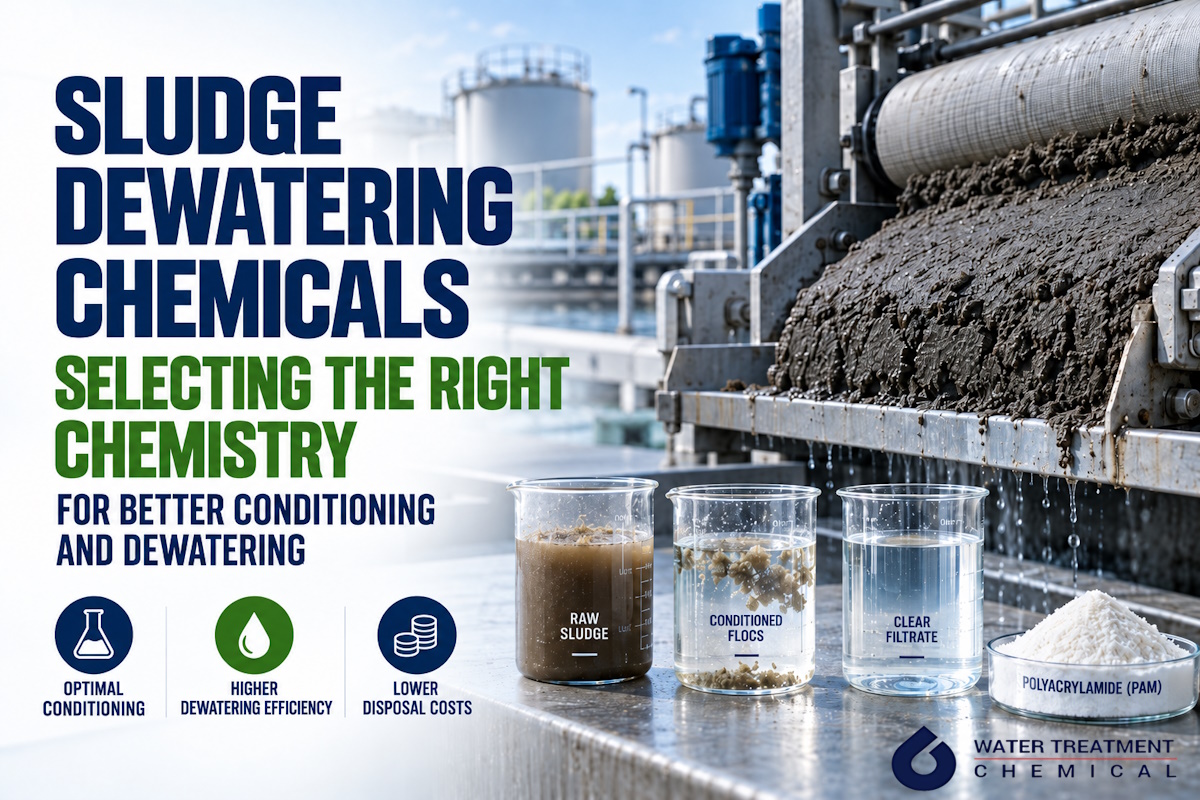
Industrial effluent treatment processes generate massive volumes of residual sludge that must be managed, treated, and ultimately disposed of. Sludge handling is one of the most resource intensive and expensive stages of industrial wastewater management, often accounting for a major portion of total plant operating costs. Because wet sludge contains high percentages of bound water trapped within the biological or chemical flocs, direct disposal without treatment is economically and logistically impractical. Effective volume reduction relies on maximizing solid-liquid separation to produce dry, manageable filter cakes.
Achieving optimal moisture reduction requires systematic chemical conditioning before the sludge reaches mechanical dewatering equipment. Without appropriate chemical intervention, colloidal particles block filter media, centrifuges output turbid centrate, and moisture content remains excessively high. Selecting high-performance sludge dewatering chemicals is crucial for destabilizing these colloidal suspensions, accelerating water release, and improving the operational lifespan of mechanical dewatering units.
Understanding the Role of Sludge Dewatering Chemicals in Industrial Treatment
Colloidal suspensions in industrial sludge carry natural negative electrostatic surface charges that repel one another, keeping solids dispersed. Sludge dewatering chemicals work by overcoming these repulsive forces through two primary mechanisms: charge neutralization and polymer bridging. When raw sludge is fed into a treatment system, its high water-binding capacity prevents gravity separation, requiring targeted chemical conditioning to alter the physical structure of the solids.
To initiate conditioning, coagulants or low molecular weight, highly charged cationic polymers are introduced to neutralize the negative surface charges on the sludge particles. Once neutralized, these micro-flocs can begin to agglomerate. High molecular weight polyelectrolytes are then added to act as flocculating agents, extending long polymeric chains into the water. These chains loop and attach to multiple particles, binding them into large, shear-resistant flocs that readily release free water. This process transforms a highly viscous slurry into a free-draining mixture of dense solids and clear water, which is necessary for mechanical dewatering processes.
Types of Sludge Dewatering Chemicals: Cationic, Anionic, and Non-ionic Polyelectrolytes
The chemical nature of the sludge dictates the specific ionic charge required for effective conditioning. Selecting the incorrect polymer charge can completely halt the dewatering process, leading to clogged filter media, wet sludge cakes, and poor solids recovery in downstream operations.
Cationic polyacrylamide (PAM) formulations are the most widely utilized polymers for biological sludge. Since biological organic solids, such as waste activated sludge from paper mills, chemical plants, and food processors, carry a strong negative charge, a high-quality cationic polyacrylamide supplier can provide the necessary positive charge density to neutralize these particles and form robust flocs. These polymers are available in various charge densities and molecular weights to suit specific biological characteristics.
For mineral-heavy, inorganic industrial sludge, anionic polyacrylamide works by interacting with positively charged metal hydroxides or mineral oxides. Facilities dealing with mining wash water, steel manufacturing effluent, or heavy chemical processing often rely on an anionic polyacrylamide manufacturer to supply polymers that facilitate rapid sedimentation and conditioning of inorganic particulates. These anionic polymers help create dense, heavy flocs that settle rapidly under gravity.
Non-ionic polymers, which carry neutral or minimal charge, find specialized utility in systems where pH levels are highly variable or where steric hindrance, rather than electrostatic attraction, is the primary driver for flocculation. Working with an experienced non ionic PAM manufacturer is essential when dealing with complex, multi-component chemical slurries that resist standard ionic conditioning approaches. These neutral polymers are highly effective in acidic conditions where ionic charges may become suppressed.
Need Help Selecting the Right Dewatering Polymers?
Key Factors Influencing Chemical Selection for Sludge Conditioning
Successful chemical selection is never a matter of using a single universal product. The chemical and physical matrix of the sludge must be thoroughly evaluated to match the conditioning agent to the specific process requirements. A failure to analyze these parameters often leads to excessive chemical consumption and poor cake dryness.
The origin of the sludge is the first critical parameter. Primary sludge, which consists of settleable solids removed directly from raw effluent, typically requires different polymer charges than secondary biological sludge or digested sludge. Biological sludge contains extracellular polymeric substances (EPS) that bind water tightly, demanding polymers with higher cationic charge densities to break the hydrophilic barrier and release trapped moisture.
Wastewater chemistry, specifically pH and total dissolved solids (TDS), also influences chemical efficacy. High TDS can compress the electrical double layer of particles but can also coil polymer chains, reducing their effective length and bridging capability. Extreme pH levels can alter the charge of both the sludge particles and the conditioning polymers, making pH control an essential step before chemical dosing.
The choice of dewatering equipment is equally influential. Centrifuges apply high centrifugal shear forces, requiring polymers with high molecular weight and linear structures that form resilient flocs. Belt filter presses require fast-draining flocs with high shear stability. Plate and frame filter presses depend on porous, non-blinding flocs that can withstand high pressure over extended press cycles.
The Impact of Sludge Characteristics on Polymer Charge and Molecular Weight
Understanding the relationship between polymer structure and sludge characteristics is fundamental to optimizing chemical consumption. Polyelectrolytes are characterized by their charge density and molecular weight, both of which must be balanced during chemical selection.
Charge density refers to the percentage of ionic monomers within the polymer chain. Low charge density polymers are suited for highly concentrated slurries where physical bridging is more critical than charge neutralization. High charge density polymers are required for thin, highly colloidal biological sludge where neutralization of negative charges is the primary barrier to floc formation.
Molecular weight refers to the length of the polymer chain. High molecular weight polymers possess longer chains, which are excellent for forming large flocs via bridging, but they are highly sensitive to physical shear. If pumped or mixed too aggressively, these chains can break, permanently losing their flocculating capability. Selecting the correct combination prevents over-conditioning, which can make the sludge slimy and cause filter cloth blinding.
Optimize Your Dewatering Plant Performance
Laboratory Evaluation: The Critical Role of Jar Testing and Buchner Funnel Tests
Because sludge composition changes constantly due to production shifts, laboratory testing is an essential prerequisite for procurement and daily plant operation. Theoretical selections must always be validated through hands-on testing using representative sludge samples from the plant.
Jar testing allows operators to evaluate the visual formation of flocs. During a jar test, various polymer formulations and dosages are introduced under controlled mixing speeds. Operators observe the rate of floc formation, floc size, and the clarity of the supernatant water. High-quality conditioning produces large, distinct flocs that rapidly separate from clear water, leaving minimal turbidity in the liquid phase.
To simulate actual filtration equipment, the Buchner funnel test or Capillary Suction Time (CST) test is utilized. The CST test measures the rate at which water is drawn out of a conditioned sludge sample through a specialized filter paper. A low CST indicates fast water release and high dewaterability. The Buchner funnel test measures the volume of filtrate collected over time under vacuum, providing a direct simulation of a vacuum filter or plate press. These laboratory trials prevent expensive trial-and-error operations on a full plant scale.
Troubleshooting Common Dewatering Failures and Chemical Issues
Dewatering operations are highly sensitive to operational upsets, and identifying the root cause of performance drops is critical to maintaining continuous plant compliance and preventing downtime.
One common issue is filter cloth blinding, where the filter media becomes clogged with fine particles or unreacted polymer. This is often caused by polymer over-dosing. When too much chemical is added, the excess polymer remains in solution, creating a viscous, sticky film that seals the pores of the filter cloth. This stops filtration, increases press cycle times, and results in wet, sloppy sludge cakes that are difficult to discharge.
Conversely, under-dosing leads to weak, fragile flocs that disintegrate under mechanical pressure. In a centrifuge, this manifests as highly turbid centrate and wet cake. In a belt press, the sludge may squeeze out from the sides of the belts rather than dewatering properly. Operators must continuously monitor cake dryness and filtrate clarity, adjusting dosing rates in response to changes in dry solids feed concentration.
Request a Custom Chemical Trial for Your Sludge
Best Practices for Preparing and Dosing Dewatering Polymers
The physical preparation of sludge dewatering chemicals is just as important as selecting the correct formulation. Most high molecular weight polyelectrolytes are supplied as concentrated powders or emulsions that must be properly dissolved and aged before use to maximize their active sites.
Dry polymers must be hydrated using specialized wetting equipment to prevent the formation of gel particles, often referred to as fish eyes. These are partially dissolved clumps of polymer surrounded by a hydrated outer layer that prevents water from reaching the core. These clumps waste active chemical and cause severe cloth blinding. The polymer solution should ideally be made down to a concentration between 0.1% and 0.5% using clean, high-quality water.
Aging time is another critical factor. Once mixed, the polymer solution must age for 30 to 60 minutes to allow the long polymer chains to fully uncoil and activate in the solution. Once prepared, the solution should be dosed using low-shear pumps, such as progressive cavity pumps, and introduced at a point in the sludge line that provides sufficient mixing without destroying the fragile flocs before they reach the dewatering zone.
Selecting the Best Dewatering Program for Your Facility
Optimizing industrial sludge conditioning requires a systematic approach that balances chemistry, equipment, and economics. Because every industrial wastewater stream has unique physical and chemical characteristics, a single chemical solution will not work for every facility. Partnering with a reliable industrial water treatment chemical supplier like Rubmech ensures access to a comprehensive suite of high-performance polyelectrolytes designed to meet stringent dewatering requirements.
To achieve consistent cake dryness and lower disposal costs, plant teams should conduct regular sludge analysis, perform routine jar testing, and maintain precise control over their polymer preparation systems. By selecting the correct ionic charge, molecular weight, and dosing concentration, industrial plants can significantly improve dewatering efficiency, protect valuable filtration equipment, and reduce overall operational expenditures. For personalized advice and high-performance products, you can make a water treatment chemical manufacturer contact to discuss your specific requirements.